
$4.00 · 8-page PDF · instant download
Secure checkout by Stripe. Instant download after payment. All sales are final once the guide is downloaded.
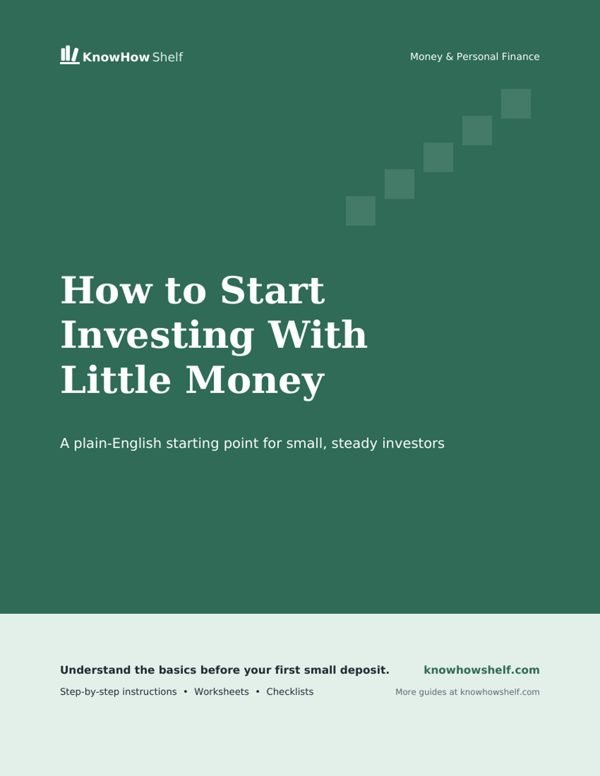
A plain-English starting point for small, steady investors
This guide is for anyone who has assumed investing is only for people with large sums to spare. It explains the core ideas, the accounts and products beginners usually encounter, what fees do to small balances, and how to build a simple, repeatable habit you can understand and control. It does not tell you what to buy. General information, not professional advice.
Investing works best when it sits on top of a stable base. Money you invest should be money you will not need for at least five years, because investment values rise and fall, sometimes sharply, and you do not want to be forced to sell during a dip just to pay a bill. Before putting anything into the market, most beginners benefit from checking three things.
None of these need to be perfect. The point is that investing should not be the thing that pushes you into an overdraft or onto a credit card when your car needs a repair.
You do not need to learn jargon to begin, but a handful of terms come up constantly. Understanding them will help you read any provider's website with confidence.
| Term | What it means |
|---|---|
| Share (stock) | A small piece of ownership in a single company. Its value moves with how investors view that company. |
| Bond | A loan you make to a government or company in exchange for interest. Usually less volatile than shares, but not risk-free. |
| Fund | A pot that pools money from many people and holds many investments at once, spreading risk across them. |
| Index fund | A fund that aims to match a market index, such as a list of the largest companies in a country, rather than trying to beat it. Typically low cost. |
| ETF | Exchange-traded fund. A fund that trades on a stock exchange like a share, often tracking an index. |
| Diversification | Spreading money across many investments so that one failing does not sink everything. |
| Compounding | Earning returns on your past returns as well as on your original money. The longer the time, the bigger the effect. |
| Volatility | How much and how quickly prices move up and down. |
The single most useful idea for a small investor is diversification. Buying one company's shares with your first deposit ties your money to one business. A broad fund spreads that same deposit across hundreds or thousands of businesses, which is why many beginner resources discuss funds first.
Funds differ in what they hold. Some track a broad national or global share market, some hold only bonds, and some mix shares and bonds in a fixed ratio. Reading a fund's factsheet tells you what it owns, its ongoing charge and its top holdings, and is a good habit to build early.
Get the rest: the full step-by-step guide plus a printable worksheet for $4.
$4
$4
$4
$4
$4
$4
$4
$4

$4
$4
$4
$4

$4
$4
$4
$4

$4
$4

$4