
$4.00 · 7-page PDF · instant download
Secure checkout by Stripe. Instant download after payment. All sales are final once the guide is downloaded.
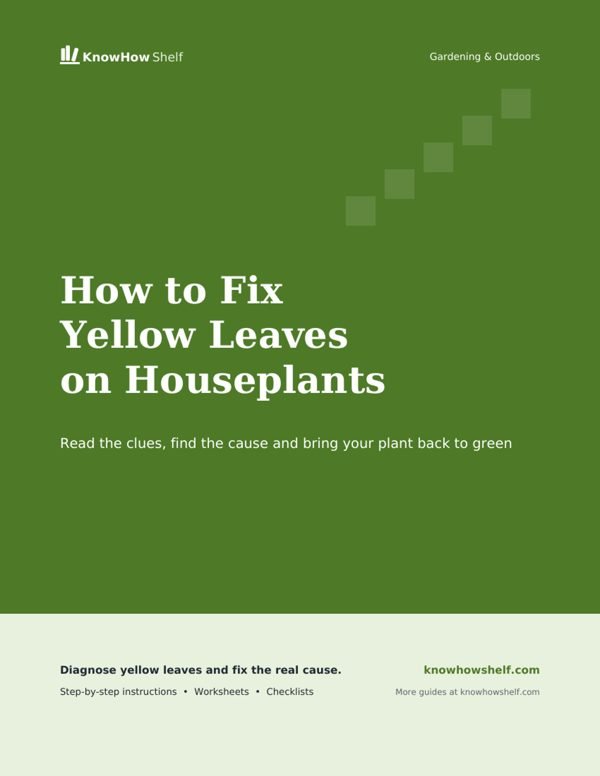
Read the clues, find the cause and bring your plant back to green
This guide is for anyone looking at a houseplant with yellowing leaves and wondering what they did wrong. Yellow leaves are a symptom, not a disease, and the pattern of yellowing tells you a lot about the cause. You will learn how to read those clues, run a quick five-minute check, and fix the most common problems: watering, light, feeding, temperature and pests. Most plants recover well once the cause is put right.
Every plant sheds old leaves now and then. If one or two of the oldest, lowest leaves turn yellow and drop while the rest of the plant looks healthy and is putting out new growth, that is usually normal ageing. The plant is reabsorbing nutrients from leaves it no longer needs. You can leave the leaf to fall or snip it off once it is fully yellow.
It is time to investigate when several leaves yellow at once, when new leaves are yellow, when yellowing comes with brown patches, spots, wilting, or a soft stem, or when the problem keeps spreading week after week. Do not respond by immediately watering, feeding or repotting. Doing the wrong thing in a hurry is the most common way a slightly unhappy plant becomes a dead one.
Where and how the yellowing appears is your best clue. Use this table as a starting point, then confirm with the checks in the next section.
| What you see | Most likely cause | Other signs |
|---|---|---|
| Lower leaves yellow and soft, compost wet | Overwatering | Musty smell, fungus gnats, drooping despite wet soil |
| Leaves yellow with crispy brown edges, compost dry | Underwatering | Compost pulling away from pot sides, pot feels light |
| Older leaves evenly pale yellow, slow growth | Lack of nutrients (often nitrogen) | Not fed for months, same compost for years |
| New leaves yellow with green veins | Nutrient uptake problem (often iron or magnesium) | Hard tap water, compost too wet or very old |
| Whole plant pale, leaning, long gaps between leaves | Too little light | Plant far from window, slow or no new growth |
| Bleached yellow or white patches on sunny side | Sun scorch | Recent move into direct sun |
| Yellow speckles, fine webbing or sticky leaves | Pests | Tiny moving dots, white fluff, honeydew |
| Sudden yellowing and leaf drop | Shock from a move, draught or cold | Recent change of position, near a door or heater |
Some popular plants have their own habits worth knowing, so you do not mistake normal behaviour for a problem.
Get the rest: the full step-by-step guide plus a printable worksheet for $4.
$4
$4
$4
$4
$4

$4

$4

$4
$4

$4

$4

$4

$4

$4

$4

$4

$4

$4

$4