KnowHow Shelf
Home / Career & Work
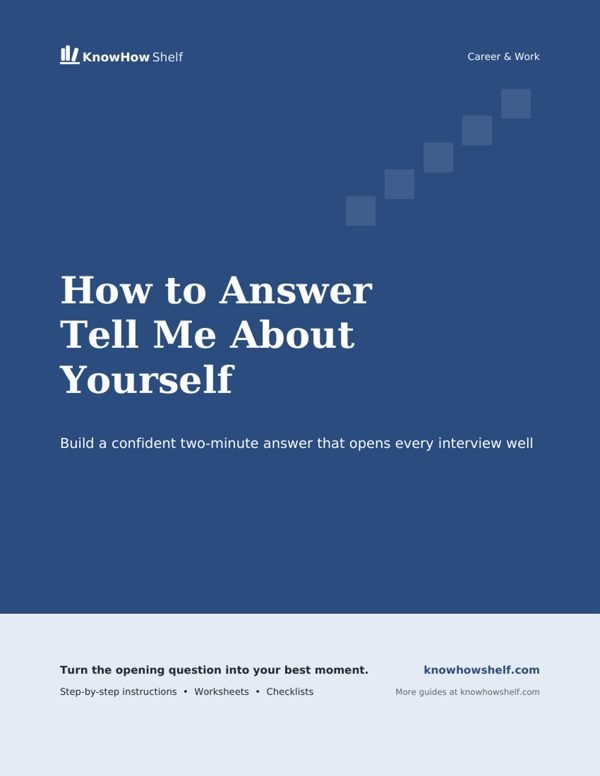
How to Answer Tell Me About Yourself in an Interview PDF guide cover

$4.00 · 7-page PDF · instant download

Secure checkout by Stripe. Instant download after payment. All sales are final once the guide is downloaded.

Career & Work

How to Answer Tell Me About Yourself in an Interview

Build a confident two-minute answer that opens every interview well

What's inside the full guide

  1. What the Interviewer Is Really Asking
  2. The Present, Past, Future Structure
  3. Choosing What to Include and What to Leave Out
  4. Example Answers You Can Adapt
  5. Adapting Your Answer to Different Situations
  6. Common Mistakes to Avoid
  7. Practising Until It Feels Natural
  8. Build Your Tell Me About Yourself Answer (printable worksheet)

Free preview

This guide is for anyone with an interview coming up who freezes, rambles or recites their whole CV when asked to talk about themselves. You will learn what the interviewer is really listening for, a simple structure that works for almost any role, and how to adapt it for phone screens, panels and career changes. By the end you will have a written, rehearsed answer you can deliver in about ninety seconds.

What the Interviewer Is Really Asking

"Tell me about yourself" sounds like an invitation to share your life story, but it is not. In almost every interview it is a warm-up question with a hidden purpose. The interviewer wants a short, relevant summary that answers one question: why are you sitting in this chair for this job?

They are also quietly checking a few other things. Can you communicate clearly without notes? Can you pick out what matters from everything you could say? Do you sound like someone who understands the role? Your answer sets the tone for the rest of the conversation, and interviewers often pick up threads from it for their next questions. That means you get to steer the interview from the very first minute.

Variations of the question include "Walk me through your background", "Tell me a bit about your experience" and "Why don't you introduce yourself?" They all want the same thing, so one well-prepared answer covers them all.

  • They want relevance, not a full timeline from school onwards.
  • They want direction: where you are heading and why this job fits.
  • They want brevity: around 60 to 120 seconds is the sweet spot.
  • They want confidence: a calm, prepared answer signals a prepared candidate.

The Present, Past, Future Structure

The simplest reliable structure has three parts. It works because it moves in a logical line and ends on the job you are interviewing for, which is exactly where you want the conversation to go next.

  1. Present: who you are now Start with your current role or situation and the one or two things you do best in it. One or two sentences is enough, for example your job title, the kind of work you handle and something you are known for.
  2. Past: how you got here Pick two or three experiences that built the skills this role needs. Choose them for relevance, not chronology. Include one concrete achievement, ideally with a real number you can back up, such as a project delivered or a process you improved.
  3. Future: why this role Finish by linking your direction to this specific job. Say what attracts you to the position or organisation and what you want to do next. This hands the conversation back to the interviewer on a positive note.

Some people prefer to open with the past, especially if they are early in their career and their current situation is study. That is fine. The key rule is that the last thing you say should point at this job.

Keep the ending sharp: Avoid trailing off with "...so yeah, that's me." Close with a clear sentence such as "That's why this role caught my attention, and I'd love to talk about how I could help the team with it." Then stop and let them respond.

Get the rest: the full step-by-step guide plus a printable worksheet for $4.
More Career & Work guides

How to Write a Resume That Gets Interviews

$4

How to Ask for a Raise and Get a Yes

$4

How to Prepare for a Job Interview

$4

How to Write a Cover Letter That Gets Read

$4

How to Change Careers Without Starting Over

$4

How to Negotiate Salary on a Job Offer

$4

How to Quit Your Job Without Burning Bridges

$4

How to Get Your Resume Past Applicant Tracking Systems

$4

How to Build a LinkedIn Profile Recruiters Notice

$4

How to Overcome Your Fear of Public Speaking

$4

How to Answer Behavioural Interview Questions Using STAR

$4

How to Explain a Gap in Your Resume

$4

How to Write a Resignation Letter

$4

How to Answer What Is Your Greatest Weakness

$4

How to Succeed as a First-Time Manager

$4

How to Find a Legitimate Remote Job

$4

How to Stay Productive When Working From Home

$4

How to Write a Resume With No Work Experience

$4

How to Stop Procrastinating at Work

$4