KnowHow Shelf
Home / Career & Work
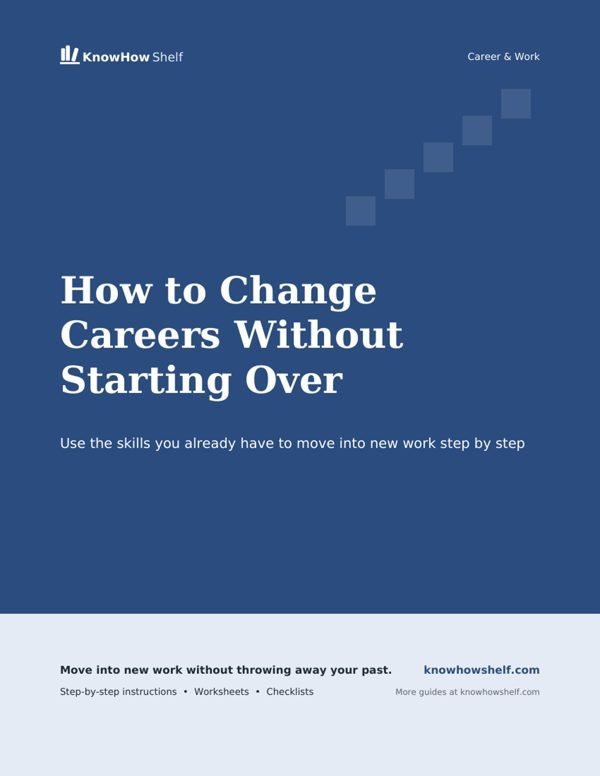
How to Change Careers Without Starting Over PDF guide cover

$4.00 · 7-page PDF · instant download

Secure checkout by Stripe. Instant download after payment. All sales are final once the guide is downloaded.

Career & Work

How to Change Careers Without Starting Over

Use the skills you already have to move into new work step by step

What's inside the full guide

  1. Why You Rarely Start From Zero
  2. Work Out What You Actually Want
  3. Map Your Transferable Skills
  4. Test Before You Commit
  5. Close the Gaps Efficiently
  6. Plan the Money and the Timing
  7. Tell Your Story and Make the Move
  8. Career Change Planner (printable worksheet)

Free preview

This guide is for anyone who wants to move into a different kind of work but worries that it means going back to the bottom, retraining for years, or taking a huge pay cut. You will learn how to work out what you actually want, identify the skills that carry over, test a new field cheaply before committing, close skill gaps efficiently, and present your background as an asset. Training costs, funding and qualification rules vary by country and industry, so this is general information, not professional advice.

Why You Rarely Start From Zero

Most people who change careers do not abandon everything they know. They move sideways, carrying a large share of their skills, experience and contacts into the new work. A teacher who moves into corporate training, an accountant who moves into data analysis, or a retail manager who moves into operations each keeps most of their core abilities and adds a smaller set of new ones.

The risk of "starting over" comes mainly from two mistakes: choosing a target with little connection to your existing strengths, and describing your past in a way that hides how relevant it is. This guide helps you avoid both. The aim is a bridge, not a leap: a route that uses what you already have as the foundation for what comes next.

  • Transferable skills such as communication, planning, managing people, handling money, solving problems and serving customers are valued almost everywhere.
  • Industry knowledge from your current field can be a major advantage in a new role that serves that same industry.
  • Your network of colleagues, clients and suppliers can open doors that job adverts never will.
  • Your track record of reliability and results counts, even if the work itself was different.

Work Out What You Actually Want

Many people know what they want to escape but not what they want to move towards. Before researching new careers, get clear on what is wrong with your current situation. Sometimes the problem is the job, sometimes the employer, sometimes the field, and sometimes the hours or pay. Each points to a different solution, and some do not require a career change at all.

  1. List what drains you For two weeks, note the tasks, situations and people that leave you tired or frustrated. Look for patterns rather than single bad days.
  2. List what energises you Note the moments when time passes quickly or you feel proud of your work, including outside your job, such as hobbies or volunteering.
  3. Name your non-negotiables Write down the minimum income you need, the hours and location you can manage, and any values you will not compromise on. Be honest about money; it shapes how fast you can move.
  4. Separate role from setting Ask whether you would enjoy your current work at a different organisation or in a different team. If yes, a job move may solve the problem faster than a career change.
  5. Draft two or three directions Based on the patterns, sketch a few possible directions. Keep them as hypotheses to test, not decisions.
Avoid the dream-job trap: There is rarely one perfect career waiting to be discovered. Most people find satisfying work by testing a few realistic options and adjusting as they learn, not by finding the answer in their head first.

Get the rest: the full step-by-step guide plus a printable worksheet for $4.
More Career & Work guides

How to Write a Resume That Gets Interviews

$4

How to Ask for a Raise and Get a Yes

$4

How to Prepare for a Job Interview

$4

How to Write a Cover Letter That Gets Read

$4

How to Answer Tell Me About Yourself in an Interview

$4

How to Negotiate Salary on a Job Offer

$4

How to Quit Your Job Without Burning Bridges

$4

How to Get Your Resume Past Applicant Tracking Systems

$4

How to Build a LinkedIn Profile Recruiters Notice

$4

How to Overcome Your Fear of Public Speaking

$4

How to Answer Behavioural Interview Questions Using STAR

$4

How to Explain a Gap in Your Resume

$4

How to Write a Resignation Letter

$4

How to Answer What Is Your Greatest Weakness

$4

How to Succeed as a First-Time Manager

$4

How to Find a Legitimate Remote Job

$4

How to Stay Productive When Working From Home

$4

How to Write a Resume With No Work Experience

$4

How to Stop Procrastinating at Work

$4