KnowHow Shelf
Home / Career & Work
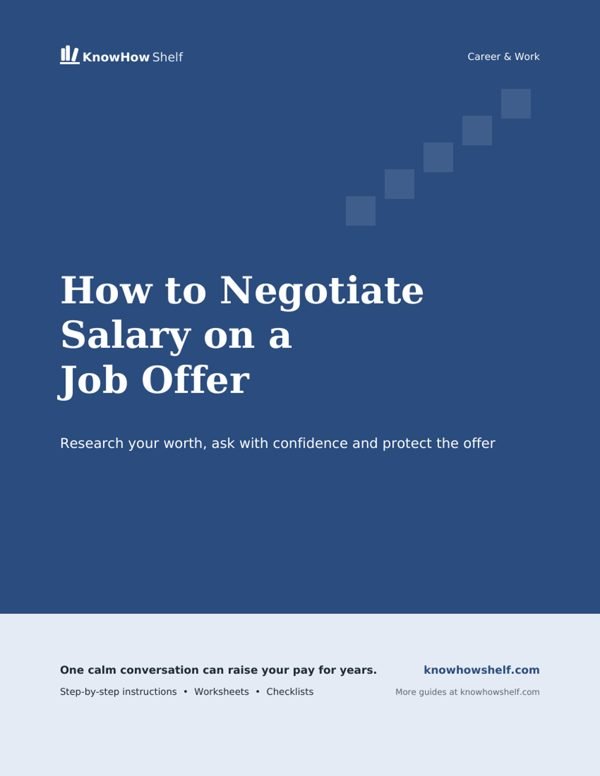
How to Negotiate Salary on a Job Offer PDF guide cover

$4.00 · 7-page PDF · instant download

Secure checkout by Stripe. Instant download after payment. All sales are final once the guide is downloaded.

Career & Work

How to Negotiate Salary on a Job Offer

Research your worth, ask with confidence and protect the offer

What's inside the full guide

  1. Why Negotiating Is Normal and Usually Safe
  2. Research Your Market Value
  3. Handle the Salary Question Before the Offer
  4. When the Offer Arrives
  5. What to Say: Making Your Request
  6. Handling Their Response
  7. Final Checks Before You Accept
  8. Salary Negotiation Planner (printable worksheet)

Free preview

This guide is for anyone who has received, or expects to receive, a job offer and wants better pay without risking the opportunity. You will learn how to research a fair number, when and how to make your request, what to say word for word, and what to do if the answer is no. General information, not professional advice.

Why Negotiating Is Normal and Usually Safe

Many people accept the first offer because they worry that asking for more will make the employer withdraw it. In practice, a polite, well-reasoned request is a normal part of hiring for many professional roles, and employers often build some room into their first figure expecting a conversation. Withdrawn offers after a respectful request are uncommon, though not impossible.

The stakes are bigger than they look. Your starting salary is often the base for future raises, bonuses calculated as a percentage, and pension contributions. A modest increase now can compound over years in the same organisation, and it can also shape what you are offered at your next job.

That said, negotiation is not always possible. Some roles have fixed pay scales, for example many public sector, union or graduate scheme positions. Even then, there may be flexibility on where you start within a band, on your start date or on other benefits. Your research will tell you which situation you are in.

It also helps to think of negotiation as a shared problem rather than a contest. The employer wants to hire you at a cost that fits their budget; you want pay that reflects the work. A calm, evidence-based conversation usually gets closer to a fair answer than either side guessing.

Know the rules where you live: Pay transparency laws vary by country, state and city. Some places require employers to publish salary ranges or ban them from asking about your current pay. Check your local government or employment rights website so you know what you are entitled to see and what you can decline to share.

Research Your Market Value

Your request needs to be grounded in evidence, not in what you need or what you would like. Good research gives you a realistic range and the confidence to state it calmly.

  1. Gather salary data Check several sources: salary comparison websites, job adverts for similar roles that list pay, published pay bands, recruiter salary guides and professional association surveys. Note the figures for your job title, level and location.
  2. Adjust for your situation Pay varies with location, industry, company size and experience. A role in a large city or a high-paying sector usually pays more than the same title elsewhere. Remote roles may be paid on a national or local scale, so ask which applies.
  3. Talk to people Recruiters, former colleagues and people in similar roles can often give a sense of what is realistic. You do not need to ask anyone their salary directly; asking "What range would you expect for this kind of role?" works well.
  4. Set three numbers Decide your target (what you will ask for), your goal (what you would be happy with) and your walk-away point (the lowest you would accept). Write them down before any conversation.

Your target should usually sit towards the upper part of the realistic range for your experience, but it must be something you can justify. Asking for a figure far above the market can damage your credibility, while a well-supported request near the top of the range is easy for an employer to take seriously.

Get the rest: the full step-by-step guide plus a printable worksheet for $4.
More Career & Work guides

How to Write a Resume That Gets Interviews

$4

How to Ask for a Raise and Get a Yes

$4

How to Prepare for a Job Interview

$4

How to Write a Cover Letter That Gets Read

$4

How to Change Careers Without Starting Over

$4

How to Answer Tell Me About Yourself in an Interview

$4

How to Quit Your Job Without Burning Bridges

$4

How to Get Your Resume Past Applicant Tracking Systems

$4

How to Build a LinkedIn Profile Recruiters Notice

$4

How to Overcome Your Fear of Public Speaking

$4

How to Answer Behavioural Interview Questions Using STAR

$4

How to Explain a Gap in Your Resume

$4

How to Write a Resignation Letter

$4

How to Answer What Is Your Greatest Weakness

$4

How to Succeed as a First-Time Manager

$4

How to Find a Legitimate Remote Job

$4

How to Stay Productive When Working From Home

$4

How to Write a Resume With No Work Experience

$4

How to Stop Procrastinating at Work

$4