KnowHow Shelf
Home / Career & Work
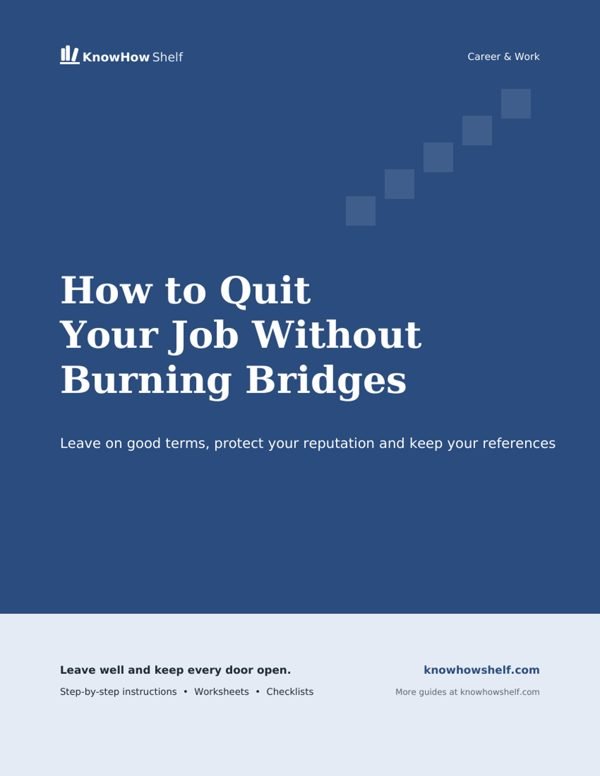
How to Quit Your Job Without Burning Bridges PDF guide cover

$4.00 · 8-page PDF · instant download

Secure checkout by Stripe. Instant download after payment. All sales are final once the guide is downloaded.

Career & Work

How to Quit Your Job Without Burning Bridges

Leave on good terms, protect your reputation and keep your references

What's inside the full guide

  1. Why How You Leave Matters
  2. Before You Resign: Prepare Quietly
  3. Telling Your Manager
  4. Writing Your Resignation Letter
  5. Handling a Counter-Offer
  6. Working Your Notice Period Well
  7. Your Last Day and Beyond
  8. Resignation and Handover Planner (printable worksheet)

Free preview

This guide is for anyone ready to leave a job who wants to do it professionally, whether they have a new role lined up or not. You will learn how to plan your exit, tell your manager, write a short resignation letter, handle a counter-offer and work your notice period so people remember you well. Employment rules vary by country and contract, so this is general information, not professional advice.

Why How You Leave Matters

The way you leave a job is often what people remember most clearly about you. A calm, organised exit can turn former managers into references, future clients or people who recommend you for roles years later. A sudden or angry exit can follow you, especially in smaller industries where people know each other.

Leaving well also protects practical things: your final pay, any accrued holiday, your reference, and in some cases bonuses or share schemes that depend on the terms of your departure. Industries and professional networks are often smaller than they appear, and the colleague you leave behind today may be interviewing you in five years.

None of this means you must stay silent about real problems. It means choosing the right channel and tone. If you have serious concerns, such as unsafe practices or discrimination, there are proper routes for raising them, and you may want independent advice from an employment adviser, union or official advice service in your country.

  • References: many employers contact past managers, even informally.
  • Rehire: some people return to former employers later, often at a higher level.
  • Networks: former colleagues move on and become hiring managers elsewhere.
  • Peace of mind: a clean exit lets you start the next chapter without loose ends.

Before You Resign: Prepare Quietly

Do the groundwork before anyone at work knows your plans. Once you resign, things can move quickly, and occasionally employers ask people to leave the same day.

  1. Read your contract Check your notice period, any rules about holiday during notice, restrictions on working for competitors or contacting clients, and whether you must return equipment. If anything is unclear or seems unusually strict, consider getting advice.
  2. Get your new offer in writing If you are moving to another job, do not resign until you have a written offer and any conditions, such as references or checks, are cleared or clearly manageable.
  3. Check your finances If you have no job lined up, work out how long your savings will last. Find out how your final pay, unused holiday and any benefits will be handled; rules on these vary by country and employer.
  4. Tidy your personal files Save personal documents, contacts and examples of your own work that you are allowed to keep. Never take confidential company information; it can create legal and reputational problems.
  5. Plan the timing Choose a date that gives your full notice and avoids leaving in the middle of a critical deadline where possible. Resigning early in the week gives time for a proper handover discussion.

If you are leaving without another job, the same principles apply, but preparation matters even more. Think about how you will describe the move to future employers in a sentence, for example "I left to take time to retrain" or "I chose to step back and focus on finding the right next role." Having that line ready makes both your resignation conversation and later interviews easier.

If you are leaving a difficult workplace, it can help to write down exactly what has happened, with dates, before you resign, and keep it privately. You may never need it, but if questions later arise about pay, references or treatment, a clear record made at the time is far more useful than memory.

Keep it to yourself: Do not tell colleagues, post on social media or update your profile before your manager knows. Hearing the news second-hand is one of the fastest ways to sour a relationship.

Get the rest: the full step-by-step guide plus a printable worksheet for $4.
More Career & Work guides

How to Write a Resume That Gets Interviews

$4

How to Ask for a Raise and Get a Yes

$4

How to Prepare for a Job Interview

$4

How to Write a Cover Letter That Gets Read

$4

How to Change Careers Without Starting Over

$4

How to Answer Tell Me About Yourself in an Interview

$4

How to Negotiate Salary on a Job Offer

$4

How to Get Your Resume Past Applicant Tracking Systems

$4

How to Build a LinkedIn Profile Recruiters Notice

$4

How to Overcome Your Fear of Public Speaking

$4

How to Answer Behavioural Interview Questions Using STAR

$4

How to Explain a Gap in Your Resume

$4

How to Write a Resignation Letter

$4

How to Answer What Is Your Greatest Weakness

$4

How to Succeed as a First-Time Manager

$4

How to Find a Legitimate Remote Job

$4

How to Stay Productive When Working From Home

$4

How to Write a Resume With No Work Experience

$4

How to Stop Procrastinating at Work

$4