KnowHow Shelf
Home / Parenting & Family
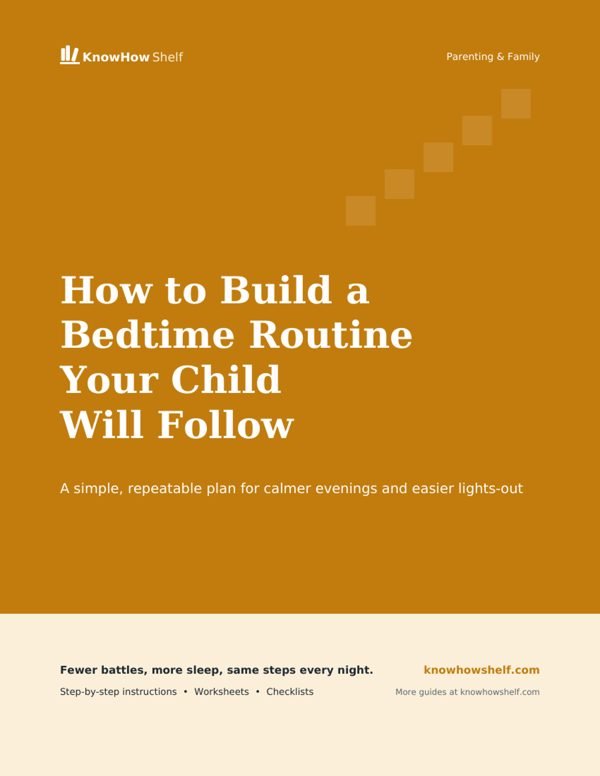
How to Build a Bedtime Routine Your Child Will Follow PDF guide cover

$4.00 · 8-page PDF · instant download

Secure checkout by Stripe. Instant download after payment. All sales are final once the guide is downloaded.

Parenting & Family

How to Build a Bedtime Routine Your Child Will Follow

A simple, repeatable plan for calmer evenings and easier lights-out

What's inside the full guide

  1. Why routines work
  2. Choose a realistic bedtime
  3. Design the routine
  4. Set up the bedroom for sleep
  5. Introduce the new routine
  6. Handle the common problems
  7. Keep it going
  8. Bedtime Routine Planner (printable worksheet)

Free preview

This guide is for parents and carers whose evenings end in stalling, negotiating or tears, and who want a bedtime that runs the same way most nights. You will learn how to pick a realistic bedtime, design a short routine your child understands, introduce it without a fight, and handle the usual problems such as curtain calls, fears and early waking. General information, not professional advice: if you are worried about your child's sleep, breathing, snoring, health or behaviour, talk to your doctor or health visitor.

Why routines work

A bedtime routine is a short, predictable sequence of calm activities that happens in the same order every night. Children of all ages tend to cope better when they know what comes next. When the steps are always the same, there is less to argue about, because the routine itself, rather than a tired parent, decides what happens.

A good routine also acts as a signal. Over a few weeks, your child's body and mind start to link the bath, the pyjamas and the story with winding down. That link is what makes falling asleep easier, not any single activity on its own.

  • Predictable: the same steps, in the same order, at roughly the same time.
  • Short: usually 20 to 45 minutes from start to lights-out. Longer routines give more room for stalling.
  • Calm: lower lights, quieter voices, no rough play or exciting screens.
  • Owned by the child: they know the steps and can tick them off, which reduces nagging.
  • Ends in the bedroom: the last steps happen where your child will sleep.
Consistency beats perfection: You do not need the ideal routine. You need one you can actually repeat on a tired Tuesday. A simple routine done most nights works better than an elaborate one done occasionally.

Choose a realistic bedtime

Start by working backwards from the time your child needs to wake up. Sleep needs vary a great deal between children and change with age, so use the recommendations from your national health service or a children's health organisation as a starting point, then adjust to your own child. Guidance differs between countries and is updated from time to time, so check a current official source rather than relying on a number you heard years ago.

  1. Fix the wake-up time Note the time your child must be up on school or nursery days. A steady wake-up time anchors the whole sleep pattern.
  2. Count back the sleep they need Use the official guidance for their age as a rough range and subtract it from the wake-up time. That gives you a target time for being asleep, not just in bed.
  3. Allow time to fall asleep Most children take a little while to drift off. Set lights-out 15 to 20 minutes before the target asleep time.
  4. Add the routine Start the routine 30 to 45 minutes before lights-out. Write this start time down; it is the time you will actually watch.
  5. Watch your child for a week If they fall asleep quickly, wake easily and are fairly cheerful during the day, the time is about right. If they fight sleep for a long time, the bedtime may be too early; if they are very grumpy or melt down in the late afternoon, it may be too late.

Overtired children often look wired rather than sleepy. Racing around, silliness and sudden tears near bedtime can be a sign that bedtime is too late, not too early. If evenings feel chaotic, try moving the whole routine 15 minutes earlier for a week and see what changes.

Get the rest: the full step-by-step guide plus a printable worksheet for $4.

More Parenting & Family guides

How to Potty Train a Toddler Step by Step

$4

How to Set Screen Time Limits Kids Actually Follow

$4

How to Stop Siblings Fighting All the Time

$4

How to Get Kids to Do Chores Without Nagging

$4

How to Make a Family Budget That Works

$4

How to Start Caring for an Ageing Parent

$4

How to Create a Morning Routine for Kids That Ends the Rush

$4

How to Help Your Child With Homework Without Doing It for Them

$4

How to Get a Toddler to Stay in Their Own Bed

$4

How to Handle Toddler Tantrums Calmly

$4

How to Make a Chore Chart by Age

$4

How to Talk to Your Parents About Moving to Assisted Living

$4

How to Write a Family Media Plan

$4

How to Decide When Your Child Is Ready for a Phone

$4

How to Night Train a Child Who Is Dry by Day

$4

How to Plan a Child's Birthday Party on a Budget

$4

How to Get Your Child to Do Homework Without a Fight

$4

How to Discipline Without Yelling

$4

How to Set Up an Allowance System That Teaches Money

$4