
$4.00 · 8-page PDF · instant download
Secure checkout by Stripe. Instant download after payment. All sales are final once the guide is downloaded.
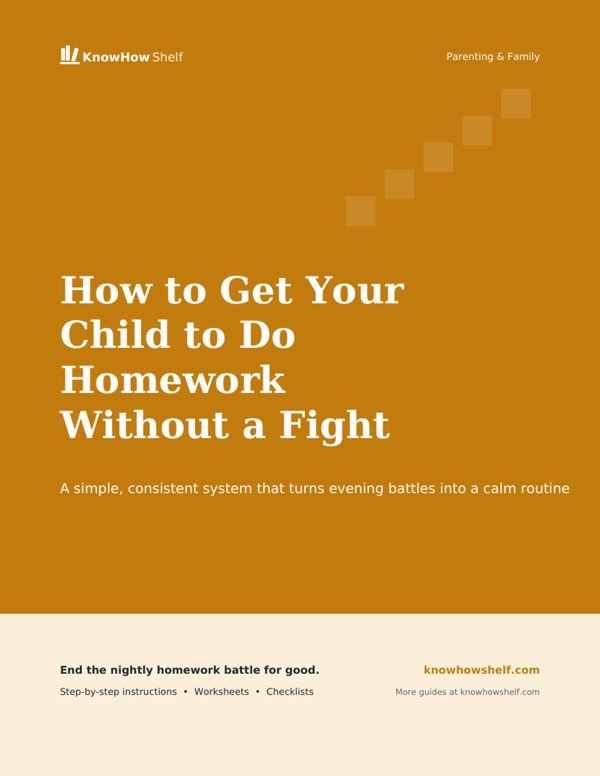
A simple, consistent system that turns evening battles into a calm routine
This guide is for parents and carers whose evenings have turned into a tug of war over homework: the stalling, the tears, the arguments and the last-minute panic. You will learn why homework fights happen, how to set up a routine and a workspace that make starting easier, what your role should and should not be, and how to handle refusal, frustration and missed work calmly. If you think your child may have a learning difficulty, attention problem or anxiety, talk to their school and your doctor; this guide is general information, not professional advice.
Homework fights are rarely about the homework itself. They usually come from a mix of tiredness, hunger, a wish to relax after a long day, uncertainty about how to start, and a parent who is also tired and worried. When you understand what is driving the resistance, you can fix the cause instead of arguing about the symptom.
| What you see | What may be behind it |
|---|---|
| Stalling and endless excuses | The task feels too big or unclear, so starting is the hardest part |
| Tears or anger | Frustration, tiredness, or worry about getting it wrong |
| Rushing and sloppy work | Wanting to get back to play or screens as fast as possible |
| Saying they have none | Forgetting, avoiding, or genuinely unclear about what was set |
| Needing you beside them constantly | Low confidence, or a habit that has built up over time |
| Arguing about when | No fixed routine, so every evening becomes a fresh negotiation |
Notice which patterns sound most like your child. Most of the fixes that follow aim at one simple goal: making it easier to start and harder to argue.
The single most effective change most families can make is a fixed homework time. When homework happens at the same time and in the same way every day, it stops being a decision and becomes a habit. There is nothing to negotiate because the answer is already known.
Write the routine down and put it somewhere visible. Younger children benefit from a picture version showing each step: snack, play, homework, then free time. Older children may prefer to plan their own weekly schedule around activities, as long as it is agreed in advance.
On days with clubs, sport or appointments, decide ahead of time when homework will fit in, or whether it will move to another day. Surprises lead to arguments; a plan made on Sunday evening prevents most of them.
Get the rest: the full step-by-step guide plus a printable worksheet for $4.

$4

$4
$4

$4
$4

$4

$4

$4
$4

$4

$4

$4

$4

$4

$4

$4

$4
$4

$4