KnowHow Shelf
Home / Parenting & Family
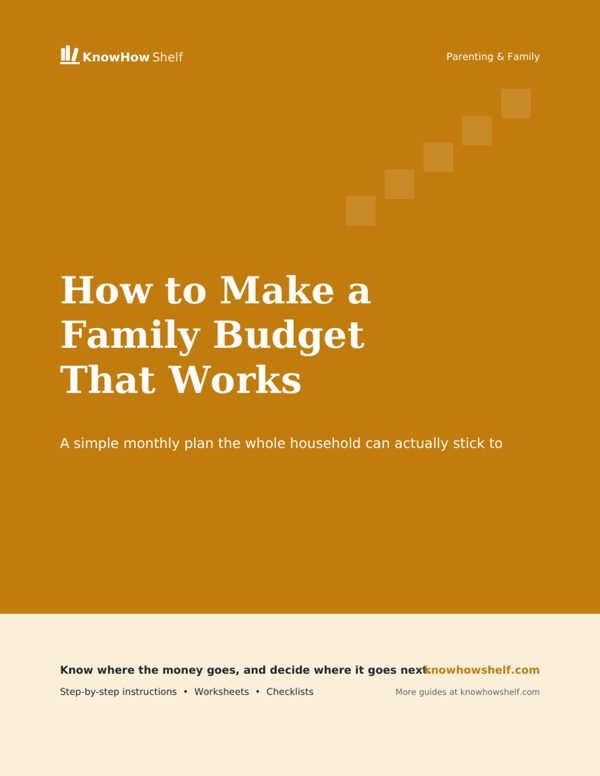
How to Make a Family Budget That Works PDF guide cover

$4.00 · 8-page PDF · instant download

Secure checkout by Stripe. Instant download after payment. All sales are final once the guide is downloaded.

Parenting & Family

How to Make a Family Budget That Works

A simple monthly plan the whole household can actually stick to

What's inside the full guide

  1. Why most family budgets fail
  2. Step one: gather your real numbers
  3. Step two: choose a simple structure
  4. Step three: build the monthly plan
  5. Planning for the costs children bring
  6. Getting everyone on board
  7. Keeping it working week by week
  8. Family Monthly Budget Planner (printable worksheet)

Free preview

This guide is for parents and carers who feel the month runs out before the money does, or who simply want to stop guessing. You will gather your real numbers, build a one-page monthly budget around your family's priorities, plan for the costs that catch families out, and set up a short weekly check that keeps it working. General information, not professional advice: if you are struggling with debt, contact a free, regulated debt advice service in your country.

Why most family budgets fail

Most budgets do not fail because people are bad with money. They fail because they were built on guesses, they ignore the irregular costs that come with children, or they are so detailed that nobody keeps them up after the second week. A family budget also has a problem a single person's budget does not: more than one person is spending, and not everyone has agreed the plan.

A budget that works has three qualities. It is based on what you actually spend, not what you hope you spend. It is simple enough to check in ten minutes. And it is agreed by the adults who spend from it, with older children given a small, clear part to play.

  • Guessed numbers: the plan looks fine on paper but the account says otherwise.
  • Forgotten irregular costs: school trips, birthdays, car repairs and winter coats arrive as 'emergencies'.
  • Too much detail: forty categories are tiring to track and easy to abandon.
  • No shared agreement: one partner budgets while the other does not know the plan exists.
  • No buffer: one bad week knocks everything over and people give up.
Mindset: A budget is not a punishment. It is a decision, made in advance, about what matters most to your family. Spending on things you care about is the point; the budget just makes sure you choose.

Step one: gather your real numbers

Before you plan anything, find out what is really happening. Set aside an hour, pull up your bank and card statements for the last two or three months, and work through them. Three months is better than one because it smooths out unusual weeks.

  1. List every source of income Write down take-home pay for each adult after tax and deductions, plus any regular child-related payments, benefits, maintenance or side income. If income varies, use the lowest typical month, not the best one.
  2. Mark your fixed costs These are the bills that are roughly the same each month: rent or mortgage, energy, water, phone and internet, insurance, childcare, loan repayments and subscriptions.
  3. Total your variable spending Group the rest into a handful of headings such as food shopping, eating out and takeaways, fuel and transport, children's activities, clothes, household items and personal spending.
  4. Find the irregular costs Scan back over the past year for anything that happens once or twice: car service, school uniform, holidays, gifts, dental or optical costs, annual memberships. Add up the year and divide by twelve.
  5. Note any debts List each debt with its balance, minimum payment and interest rate. You need this before you can decide what to do about it.
Do not judge yet: While gathering numbers, just record. It is common to be surprised by food, takeaway or subscription totals. Surprise is useful information, not a reason to feel guilty.

Get the rest: the full step-by-step guide plus a printable worksheet for $4.

More Parenting & Family guides

How to Potty Train a Toddler Step by Step

$4

How to Build a Bedtime Routine Your Child Will Follow

$4

How to Set Screen Time Limits Kids Actually Follow

$4

How to Stop Siblings Fighting All the Time

$4

How to Get Kids to Do Chores Without Nagging

$4

How to Start Caring for an Ageing Parent

$4

How to Create a Morning Routine for Kids That Ends the Rush

$4

How to Help Your Child With Homework Without Doing It for Them

$4

How to Get a Toddler to Stay in Their Own Bed

$4

How to Handle Toddler Tantrums Calmly

$4

How to Make a Chore Chart by Age

$4

How to Talk to Your Parents About Moving to Assisted Living

$4

How to Write a Family Media Plan

$4

How to Decide When Your Child Is Ready for a Phone

$4

How to Night Train a Child Who Is Dry by Day

$4

How to Plan a Child's Birthday Party on a Budget

$4

How to Get Your Child to Do Homework Without a Fight

$4

How to Discipline Without Yelling

$4

How to Set Up an Allowance System That Teaches Money

$4