
$4.00 · 8-page PDF · instant download
Secure checkout by Stripe. Instant download after payment. All sales are final once the guide is downloaded.
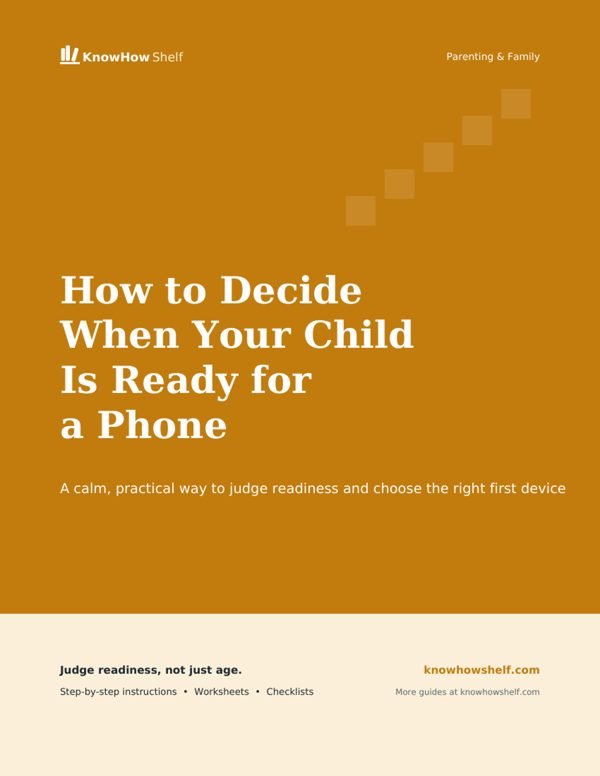
A calm, practical way to judge readiness and choose the right first device
This guide is for parents and carers facing the first-phone question and wanting a better answer than whatever the other parents at the school gate are doing. You will learn how to separate your child's real needs from social pressure, judge their readiness with clear signs, choose a first device that fits, and set it up with agreements that protect them. General information, not professional advice: for concerns about your child's wellbeing or online safety, talk to your doctor, your child's school, or official online safety guidance in your country.
Parents often search for the correct age to give a child a phone, but there is no age that suits every child. Children mature at different rates, families have different routines, and the reasons for wanting a phone vary enormously. A ten-year-old who walks to school alone may need a way to call home far more than a thirteen-year-old who is driven everywhere.
Some campaigns, schools and health bodies have published views on when children should have smartphones or social media, and a number of countries have set or are discussing legal age limits for social media accounts. These positions differ and change over time, so check the current guidance from your school, your national health or education authority, and the minimum ages in each app's terms of service.
A more useful question than what age? is what does my child need, and are they ready for the responsibilities that come with it? Answering it means looking at three things separately: the need, the child's readiness, and the type of device.
Write down why a phone is being considered right now. Be honest about whose need it is: yours, your child's, or a feeling of pressure because others have one. All of these are understandable, but they lead to different answers.
| Reason | What it actually requires |
|---|---|
| Travelling to school or activities alone | Calls and texts with family; possibly location sharing |
| Splitting time between two homes | Easy contact with both parents |
| Staying in touch with friends | Messaging; not necessarily social media or a smartphone |
| Everyone else has one | Worth exploring: what is your child missing out on, exactly? |
| School needs or homework | Often met by a shared family computer or tablet instead |
| Parent peace of mind | May be met by a basic phone or a watch with calling |
When you match each reason to what it actually requires, you will often find that the need is narrower than a full smartphone. That gives you room to start small and expand later, which is much easier than taking features away once they have been given.
If social pressure is the main driver, take it seriously. Being left out of group chats can genuinely affect friendships. Ask your child what they feel they are missing, and talk to other parents in the class; you may find that several families would happily delay together, which removes much of the pressure for everyone.
Get the rest: the full step-by-step guide plus a printable worksheet for $4.

$4

$4
$4

$4

$4

$4
$4

$4
$4

$4

$4

$4
$4

$4

$4

$4

$4

$4

$4