KnowHow Shelf
Home / Emergencies & Crisis
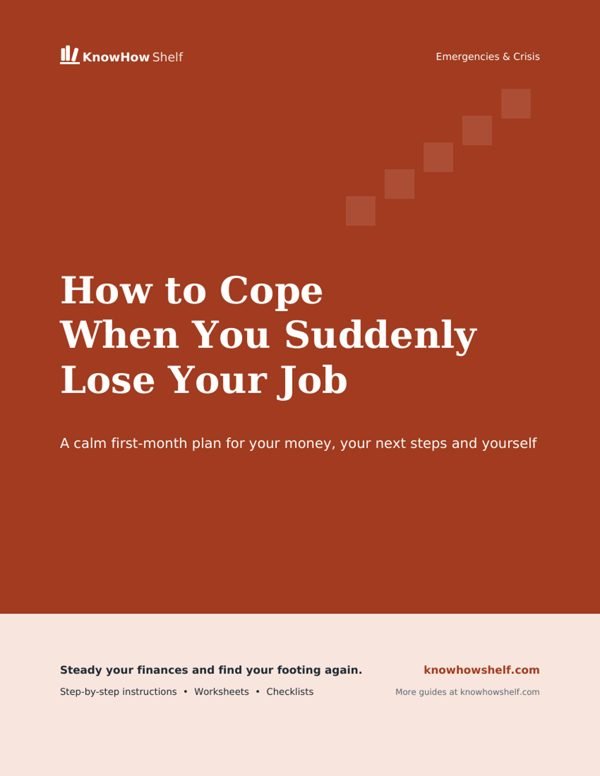
How to Cope When You Suddenly Lose Your Job PDF guide cover

$4.00 · 8-page PDF · instant download

Secure checkout by Stripe. Instant download after payment. All sales are final once the guide is downloaded.

Emergencies & Crisis

How to Cope When You Suddenly Lose Your Job

A calm first-month plan for your money, your next steps and yourself

What's inside the full guide

  1. The First 24 Hours
  2. Protect Your Income in Week One
  3. Build a Survival Budget
  4. Talk to Lenders and Landlords Early
  5. Plan Your Next Step
  6. Look After Yourself and Your Household
  7. Your First-Month Checklist
  8. Job Loss Survival Budget and Action Plan (printable worksheet)

Free preview

This guide is for anyone who has just been made redundant, laid off or let go without warning, and for people who fear it is coming. You will learn what to do in the first 24 hours, how to protect your income and housing, how to build a survival budget, where to look for support and how to look after your wellbeing while you plan your next step. Rules on notice, redundancy pay and benefits vary by country and sometimes by region, so check official government sources for what applies to you. General information, not professional advice.

The First 24 Hours

Losing a job suddenly is a shock, and it is normal to feel angry, embarrassed, numb or frightened. You do not need to make big decisions today. What helps most in the first day is to gather information, avoid signing anything in a hurry, and give yourself a little space.

  1. Ask for it in writing Request written confirmation of your dismissal or redundancy, your last working day, and the reason given. This is often needed for benefit claims and any later questions.
  2. Clarify what you are owed Ask when your final pay will arrive and what it will include, such as unpaid wages, holiday or leave you have earned but not taken, notice pay and any redundancy or severance payment.
  3. Do not sign straight away If you are offered an agreement, such as a settlement or severance agreement, ask how long you have to consider it. In many countries you can, or must, get independent advice first. A free employment advice service, trade union or adviser can explain your options.
  4. Save your records Before your work accounts are closed, make sure you have personal copies of your contract, payslips, pension details and any appraisals that you are entitled to keep. Do not take confidential company information.
  5. Tell the people you live with Share the news with your partner or household when you feel ready. Facing it together usually makes the next steps easier.
Write it down: Keep a simple notebook or document with dates, names and what was said in each conversation with your employer. Memory gets hazy under stress, and notes can help if questions come up later.

Protect Your Income in Week One

The single most useful thing you can do in the first week is to start any claims for financial support you might be entitled to. In many places, claims can only be backdated a short time, or not at all, so delays can cost you money.

  • Unemployment or jobseeker benefits: most countries have some form of support for people who lose work. Search your government's official website for unemployment benefit or jobseeker support and check the eligibility rules.
  • Help with housing costs: some schemes help with rent or mortgage interest when income falls. Ask your local authority or housing department what exists.
  • Health cover: if your health insurance came through your job, find out when it ends and what your options are for continuing or replacing it.
  • Insurance policies: check whether you have income protection, loan protection or mortgage payment protection insurance that could pay out after redundancy.
  • Pension: find out what happens to your workplace pension and avoid cashing it in hastily; early withdrawals can carry large tax costs or penalties. Ask the pension provider or a free government pension guidance service for help.

If you are unsure where to start, a free, independent advice service, such as a citizens' advice organisation, debt charity or government helpline, can help you understand which support you can claim. Be wary of paid services that promise to get you benefits faster.

When you apply, have your documents ready: identification, your bank details, your employer's written confirmation of your job ending, recent payslips and details of your rent or mortgage. Write down the date of every application, any reference numbers and the names of people you speak to. If a claim is refused and you think the decision is wrong, most systems have a way to ask for it to be looked at again, usually within a set time limit, so act quickly and ask an advice service for help.

If you have a partner, check how their income affects what you can claim, and talk openly about how you will share costs for the next few months. If you are self-employed or were on a short-term contract, the support available may be different, so check the official rules for your situation.

Get the rest: the full step-by-step guide plus a printable worksheet for $4.
More Emergencies & Crisis guides

How to Build a Home Emergency Kit Step by Step

$4

How to Get Through a Power Outage Safely at Home

$4

How to Make a Household Emergency Plan That Everyone Knows

$4

How to Recover After Your Home Floods

$4

How to Make a Home Fire Escape Plan

$4

How to Keep Your Home Cool in a Heatwave Without Air Conditioning

$4

How to Pack an Evacuation Grab Bag

$4

How to Handle It When You Can't Pay Rent This Month

$4

How to Make an Insurance Claim After a Flood or Fire

$4

How to Store Emergency Water for Your Household

$4

How to Prepare Your Home Before a Big Storm

$4

How to Stay Safe if You're Stranded in a Car in Snow

$4

How to Protect Yourself and Your Home From Wildfire Smoke

$4

How to Build an Emergency Fund When Money Is Tight

$4

How to Prepare for an Earthquake at Home

$4

How to Keep Important Documents Safe for Emergencies

$4

How to Make a Family Emergency Communication Plan

$4

How to Keep Food Safe When the Power Goes Out

$4

How to Prepare Your Pets for an Emergency

$4